
Welcome to our guide on how SEO content helps small businesses compete online.
Most small businesses don’t have the ad budget to compete with bigger enterprises. But the truth is, you don’t always need one. The right kind of content can get your business in front of the right people at the right time, without paying for every click.
Our team here at SEO Sandwich has helped dozens of small companies produce content that performs in search. We understand the factors that influence both rankings and conversions.
In this guide, we’ll cover:
- How SEO content helps small businesses compete
- What good SEO content looks like in practice
- The role AI plays in content creation right now
Read on to find out how successful enterprises use content to increase visibility.
How Does SEO Content Help Small Businesses Compete?
SEO content can help small businesses compete by bringing in organic traffic, improving search rankings, and building trust with potential customers without spending on ads. It’s one of the few marketing strategies that keeps working long after you publish your content.

Below are some of the reasons search engine-optimised content remains a valuable asset for small businesses:
- Higher Search Rankings: Quality content helps small businesses rank higher on Google. Search engines look at how well your page answers a query, how long visitors stay, and whether other sites link back to it. That’s likely to get you to the first page.
- More Organic Traffic: Around 53% of all website traffic comes from organic search. That’s why a well-written blog post can keep pulling visitors to your site for months (sometimes years, even). In comparison, a social media post usually disappears from feeds within hours.
- Local Search Visibility: If you’re a small business in a specific area, local SEO content can help you increase your presence online. In fact, Google gives priority to pages that match location-based searches. And once that local traffic starts flowing, it’s much easier to build a loyal customer base.
- Trust and Credibility: Helpful content allows businesses to showcase their expertise at scale. For instance, a Brisbane accounting firm that publishes practical tax guides gives potential clients a reason to trust its advice before they’ve even picked up the phone.
- Cost Savings Over Paid Advertising: While both SEO and paid advertising require investment, SEO content has the potential to keep attracting visitors long after the initial work is done. Paid campaigns, by contrast, only generate traffic while they’re actively funded.
In short, you don’t need a massive budget to compete online. The right content can help your business get found by the people already searching for what you offer.
What Does Good SEO Content Look Like for a Small Business?
Good SEO content for a small business is well-researched, written for real people, and optimised for search engines at the same time. It just needs to answer the right questions in a way that Google and your readers both understand, rather than being packed with industry jargon.
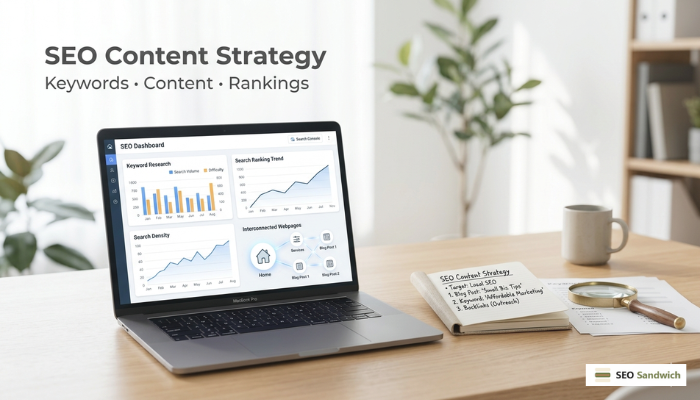
We’ll now explain how these approaches work.
Keyword Research and Planning
Have you ever wondered how some small businesses keep showing up on the first page of Google? The whole thing usually starts with keyword research. Tools like Google Analytics and free keyword planners show you exactly what your target audience is typing into search engines.
In particular, you need to focus on relevant keywords with lower competition and high intent, instead of just the ones with the biggest search volume. That way, you’re not wasting time on terms you’ll never rank for.
A clear content strategy built around those keywords will also keep you from falling into the keyword stuffing trap (Google penalises it pretty heavily).
Writing for Your Audience
The best SEO content will answer the exact questions your customers are already typing into Google. That’s why you need to write your piece in plain language by using short paragraphs and keeping a natural brand voice throughout. Otherwise, you risk not achieving your goal of increased online visibility.
For example, if your reader has to re-read a sentence twice, it’s too complicated. Google’s algorithm can recognise this issue, too. But if visitors stay longer on your pages and engage more, it’ll likely rank higher than pages people bounce from instantly.
So when your content genuinely helps someone, it’s doing double duty for both your audience and your search rankings.
Content Principle: The more effort a reader has to spend understanding your content, the less attention they have left for your message.
On-Page SEO Elements
You could write the best blog post in your industry and still not rank. The reason is the lack of on-page SEO elements like title tags and meta descriptions. They tell search engines what your page is about.
Plus, since they’re the first thing people see in search results, they need to be clear and include your key terms. Your headings, URLs, and image alt text all play a role in on-page SEO as well.
But the good thing is that you can fix these issues quickly. Even small on-page tweaks can give your SEO performance a noticeable bump.
Internal Linking and Blogging
Many people don’t realise that the pages on their website need to connect to one another. While every new blog post gives search engines fresh content to crawl, the real value comes from how those pages are linked together through internal links.
Let’s say you’ve got a services page and a blog post about the same topic. When you connect them with a link, you’re basically telling Google that both pages are related and worth ranking (think of it as creating pathways through your website).
That authority spreads across your site over time, including to your product pages and other articles.
What Role Does AI Play in Small Business SEO Content?
AI now plays a direct role in how small businesses create SEO content and how Google displays search results.
Here’s how AI is influencing small businesses’ content creation right now:
- Content Creation With AI Tools: Generative AI can help writers get from a blank page to a first draft faster. However, the content still needs human input to ensure it’s accurate, insightful, and genuinely useful. We strongly recommend taking the time to edit and verify the information before publishing your article.
- AI Overviews and Zero-Click Searches: Recent data shows that around 60% to 68% of Google searches now end without a single click, since Google’s AI overviews pull answers straight onto the results page. So your content needs a clear structure and direct answers under each heading to stay visible in search engines.
- Keeping Your Brand Voice: Your audience can usually tell when content feels generic or robotic. While AI can speed up the writing process, it often produces similar-sounding content that’s missing a distinct voice. That’s why it’s important to refine AI-generated drafts with your own personality, expertise, and tone.
In other words, the competitive advantage no longer comes from producing more content, but from producing better content.
Where to Go From Here With Your SEO Content Strategy
Although big brands often have larger marketing budgets, SEO gives small businesses an opportunity to compete. You just have to know how to create relevant content, target the right search terms, and stay consistent over the long term.
But you don’t need to do everything at once. You may start with one or two blog posts around topics your customers are already searching for. Then optimise your on-page elements, connect your pages with internal links, and keep your content sounding like you rather than a robot.
And if you’re not sure where to begin, reach out to our team. We’ll help you build an SEO content strategy that fits your business goals and gets you in front of the right audience.

