
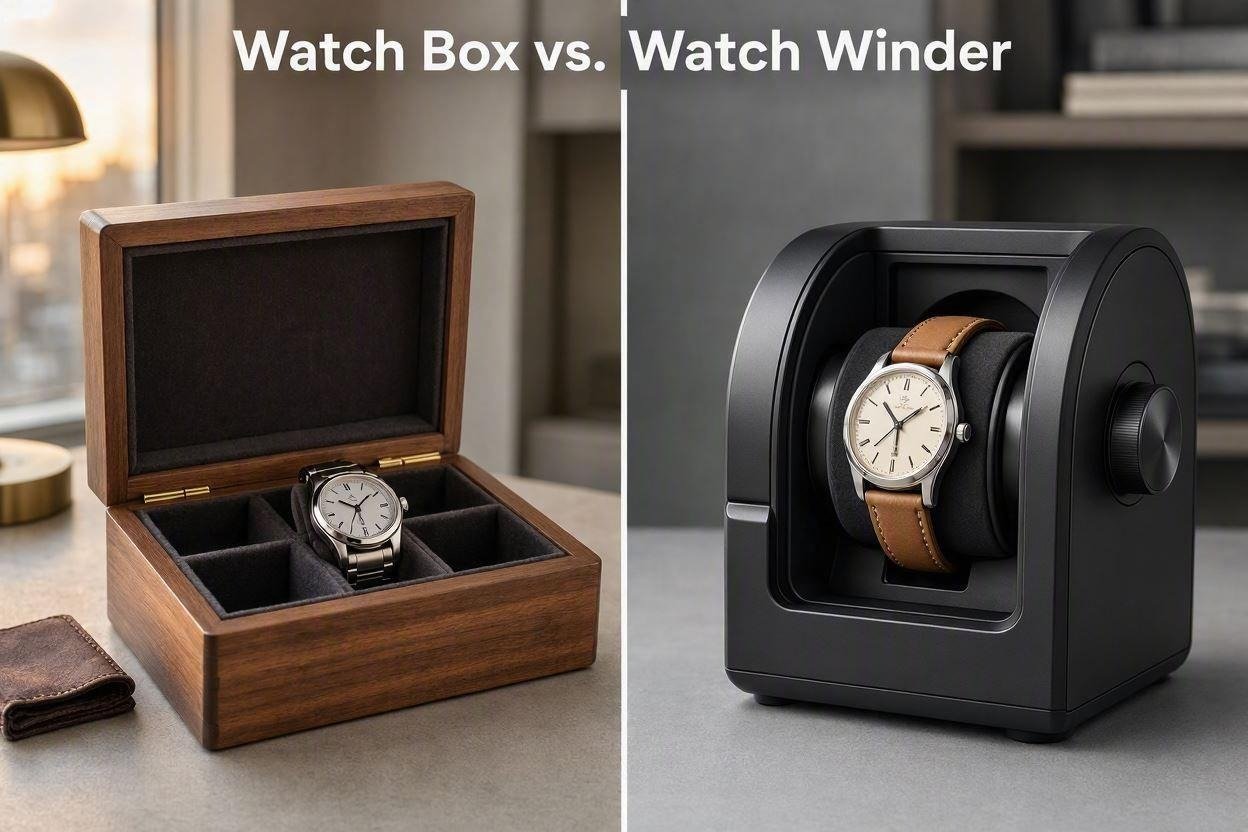
If you’ve just bought your first automatic watch, you’ve probably run into this question fast: do you need a watch box, a watch winder, or both? It’s a fair question, and the answer isn’t the same for everyone. It depends on how many watches you own, how often you wear them, and how much you actually want to spend on storage.
This guide breaks down exactly what each option does, who needs which one, and how to make the right call for your own collection.
What’s the Real Difference Between a Watch Box and a Watch Winder?
A watch box is simple storage. It holds your watches, protects them from dust and scratches, and keeps them organised. It does nothing else. If your watch stops because it hasn’t been worn, a box won’t restart it. You’ll need to manually wind it or reset the time and date yourself.
A watch winder is an active device. It gently rotates an automatic watch on a set schedule so the internal rotor keeps moving, which keeps the mainspring wound. This means the watch stays running and fully set, even when it’s sitting in a drawer instead of on your wrist.
So the short version: a box stores your watch. A winder keeps it alive.
Do You Actually Need a Watch Winder?
Not everyone does. This is where a lot of new watch owners overspend on gear they don’t need.
You’ll genuinely benefit from a watch winder if:
- You own multiple automatic watches and rotate between them
- Some of your watches sit unworn for more than a day or two at a time
- Your watch has a complicated calendar function (day, date, moonphase) that’s a hassle to reset every time it stops
- You want the watch ready to wear the instant you pick it up
You probably don’t need one if:
- You wear the same watch daily
- You only own one automatic piece
- You don’t mind the two-minute process of resetting time and date
If your watch never sits still long enough to stop, a winder isn’t solving a problem you have. In that case, a well-made box is all you need, and you can check it out for a housing that suits your case size and collection.
Why a Good Watch Box Still Matters, Even With a Winder
Some collectors assume that once they own a winder, the box becomes irrelevant. That’s not quite right.
Winders are usually built into or paired with a box-style housing anyway, but a dedicated box still earns its place for:
- Travel. Winders aren’t practical to pack. A compact box protects your watch on the move.
- Overflow storage. Most winders only rotate one or two watches at a time. Anything beyond that still needs a home.
- Display and organisation. A good box keeps straps from tangling, cases from scratching against each other, and everything visible at a glance.
Think of the box as the foundation of watch storage and the winder as an optional upgrade layered on top for the pieces that need it.
How Humidity, Temperature, and Positioning Affect Both Options
Whichever storage method you choose, the environment matters more than most people realise. Automatic movements are precise mechanisms, and both moisture and temperature swings can affect gaskets, lubrication, and long-term accuracy.
The core rules are consistent whether the watch sits in a box or a winder:
- Keep it away from direct sunlight and radiators
- Avoid damp rooms like bathrooms
- Store it in a stable, moderate-temperature space
- Position the watch correctly if it’s a manual-wind piece being stored long-term
Aevitas covers this in detail in Aevitas’s The Ultimate Guide How to properly store a Swiss automatic watch, including specific guidance on humidity control and positioning that applies whether you’re using a box, a winder, or switching between the two depending on the season or your travel schedule.
How Many Rotations Per Day Does a Watch Winder Need?
This is one of the most common questions people search before buying a winder, and the answer depends on the watch, not a universal number.
Most automatic movements need somewhere between 650 and 950 rotations per day to stay fully wound. Manufacturers usually publish this figure, or it’s easy to find via a quick search of the specific caliber. Rolex movements, for example, typically run on the lower end of that range, while some Swiss movements from brands like Omega or Tudor sit slightly higher.
Direction matters too. Some movements wind in both directions (bidirectional), while others only wind one way (clockwise or counter-clockwise). Using the wrong setting won’t damage the watch, but it will mean the winder is working without actually winding it, which defeats the purpose entirely. Most quality winders let you set both rotation count and direction, so check your watch’s specifications before configuring the device.
Cost Comparison: Box vs. Winder vs. Both
Budget is often the deciding factor, so here’s a realistic breakdown:
Watch box only: The most affordable option. A quality box with proper cushioning and a secure clasp will protect your collection for years without any ongoing cost or maintenance.
Watch winder only: More expensive upfront, and it draws power continuously if left running. Worth it primarily for complicated or frequently rotated pieces.
Both: The most complete setup, and honestly the most common choice among people with more than two or three automatic watches. The box handles storage and travel; the winder handles the pieces in active rotation.
There’s no need to buy the most expensive option in either category. A mid-range box with solid build quality and a winder with adjustable settings will cover almost every collector’s needs.
Signs You’ve Outgrown a Basic Box
If any of these sound familiar, it might be time to add a winder to your setup:
- You’re manually resetting the same watch two or three times a week
- You’ve started avoiding wearing a particular piece because resetting the calendar function is annoying
- Your collection has grown past what fits comfortably in one drawer or box
- You’re gifting or inheriting a watch with a perpetual calendar, where a stopped movement means a much more involved reset
None of these are dealbreakers on their own, but together they usually signal that a winder will save you real time and hassle.
Final Thoughts
There’s no single right answer to the box-versus-winder debate. It comes down to how you actually use your watches. A single daily-wear piece rarely needs a winder. A growing collection with complicated movements almost always benefits from one. Most collectors end up with both eventually, using the box as the base layer for storage and travel, and the winder as the tool that keeps their most-worn or most complicated pieces ready to go.
Whatever you decide, take the storage environment seriously. A quality box or winder is only doing half the job if the watch is sitting in a hot, humid, or sunlit spot. For a closer look at both options, visitAevitas UK directly.
For a deeper technical reference beyond brand-specific guidance, theHorological Society of New York publishes accessible educational material on mechanical movements, useful for anyone who wants to understand the mechanics behind why winding matters in the first place.
FAQs
Do watch winders damage automatic watches? No, not when used correctly. A quality winder with the correct rotation count and direction for your specific movement causes no more wear than normal daily use. Overwinding isn’t a real risk with modern automatic movements, since they have a slipping clutch mechanism that prevents mainspring damage.
Can I leave my watch winder running all the time? Yes, most winders are designed for continuous use. Some models include a rest mode that runs a few hours on, then off, to mimic natural wear patterns, but constant operation won’t harm the movement.
How long does an automatic watch stay wound without a winder? Power reserve varies by movement, typically between 40 and 70 hours for most modern automatics. Some high-end movements offer extended reserves of a week or more. Check your specific model’s specifications for an exact figure.
Is it bad to store a watch in a drawer without a box? It’s not ideal. A drawer offers no cushioning against scratches, no protection from dust, and no humidity control. Even a basic box is a meaningful upgrade over loose drawer storage.
Do I need a different winder for every watch in my collection? No. Most people use a multi-watch winder that rotates several pieces on independent or shared settings, then keep the rest of their collection in a box until they’re next worn. You don’t need one winder slot per watch unless every piece in your collection needs to be ready to wear at all times.

