
The generative AI revolution has reshaped digital production by enabling creators to transform simple prompts into cinematic video sequences. Modern AI video generator platforms eliminate traditional production constraints such as filming logistics, equipment costs, and post-production complexity. Instead, they interpret natural language instructions to construct environments, simulate physics, and generate visually coherent motion scenes within minutes.
As demand for short-form and long-form video content continues to rise across marketing, entertainment, and social platforms, selecting the right generation system has become a critical strategic decision. Each AI video generator differs in model architecture, prompt understanding, motion fidelity, and workflow integration. This analysis explores five leading platforms, evaluating their strengths in real-world production environments and creative scalability.
1. Pollo AI
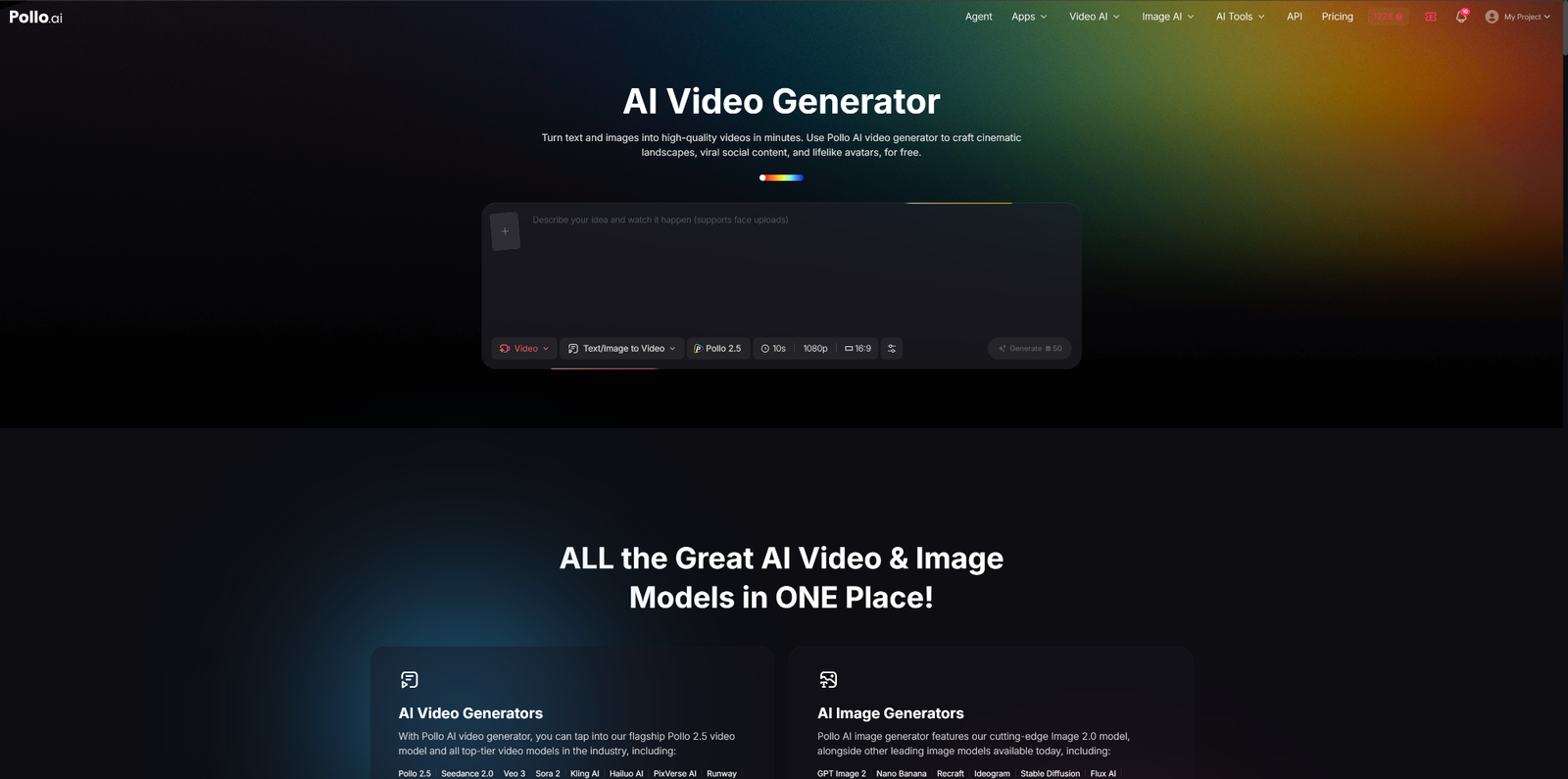
Pollo AI is a large-scale AI video generator ecosystem designed to unify multiple advanced video and image models into a single production environment. Instead of relying on a single generation engine, it integrates a wide model library including Pollo 2.5, Seedance 2.0, Veo 3, Kling AI, Runway, Luma AI, and many more. This multi-model structure allows creators to dynamically choose the most suitable engine for different creative tasks such as cinematic storytelling, advertising content, or social media videos. The platform supports text-to-video, image-to-video, reference-to-video, and video-to-video generation, enabling a fully flexible production workflow.
Beyond model integration, Pollo AI functions as a complete content production system with over 100 specialized applications and tools. It supports UGC video ads, product videos, testimonial videos, Facebook ad creatives, clone viral videos, faceless videos, and YouTube outro video generation. It also includes music-driven formats such as narrative music videos and lyric videos, along with AI avatar video generation, animation tools, and prompt-based video editing. Additional capabilities include AI video upscaling, lip sync, face swap, video enhancement, and hundreds of ready-made AI effects such as Earth Zoom, AI Hug, action transformations, and cinematic transitions.
Pollo AI also provides a streamlined workflow that connects model selection, prompt generation, editing, and export into a unified system. This eliminates fragmentation across multiple tools and allows users to produce professional-grade content directly within a single environment, significantly improving production speed and consistency across campaigns.
Why is it valuable
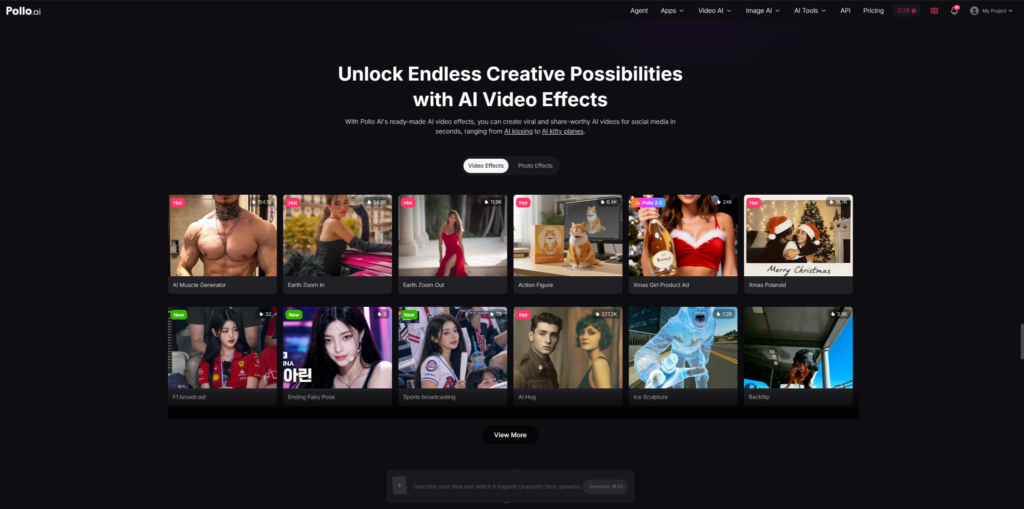
Pollo AI is highly valuable because it consolidates an entire AI video production pipeline into one ecosystem, eliminating the need for multiple disconnected tools. It enables creators to scale content production across marketing, entertainment, and social media with high efficiency, while maintaining creative flexibility through multi-model selection. The platform is especially useful for agencies, brands, and content teams that require rapid iteration, consistent output quality, and cross-platform adaptability. Its combination of generation models, editing tools, and automated workflows makes it one of the most complete AI video production infrastructures available today. It is also particularly effective as a “YouTube outro maker” allowing creators to quickly generate polished, branded ending sequences that improve viewer retention and channel professionalism without requiring separate editing software.
2. Seedance 2.0
Seedance 2.0 is a precision-focused AI video generator designed for creators who require strict control over visual consistency and motion behavior. It uses a reference-based generation system where characters, environments, and objects remain locked across frames, ensuring stable identity preservation throughout the entire video. This architecture prevents common generative issues such as facial drift, clothing changes, or background inconsistencies, making it highly reliable for structured production pipelines and narrative continuity.
The platform also includes a fast preview generation mode that allows users to quickly test scene composition, camera angles, and motion paths before committing to full-resolution rendering. Its engine is optimized for physically accurate simulations, including lighting behavior, fabric dynamics, and spatial depth consistency. Additionally, Seedance 2.0 supports full 360-degree camera movement while maintaining object stability, allowing scenes to be explored from multiple angles without visual distortion or structural breakdown.
Why is it valuable
Seedance 2.0 is valuable because it prioritizes predictability and control over randomness, making it ideal for professional animation workflows and structured storytelling environments. It is widely used in studios, educational content production, and serialized media development where consistency across frames and scenes is essential. By ensuring stable character identity and spatial accuracy, it reduces post-production correction work and improves production reliability. This makes it particularly useful for teams that require repeatable results, technical precision, and strict visual continuity across multiple video assets.
3. Luma AI
Luma AI, powered by its Dream Machine architecture, is a physics-aware AI video generator designed to produce highly realistic motion grounded in real-world dynamics. It excels at simulating natural behaviors such as fluid movement, vehicle motion, and organic human actions while maintaining spatial coherence. Built on advanced neural rendering and 3D reconstruction principles, it ensures that generated environments remain structurally consistent and visually believable across all frames.
The system dynamically interprets prompts and adjusts lighting, perspective, and environmental interactions in real time. This makes it highly effective for rapid prototyping of cinematic sequences, game environments, and visual effects concepts. Its camera system generates smooth, stabilized motion that replicates professional filming equipment, avoiding jitter or unnatural transitions. It also preserves sharp focus and clean object boundaries even during fast or complex motion sequences, making outputs immediately usable for pre-visualization workflows.
Why is it valuable
Luma AI is valuable because it bridges the gap between physical simulation and generative video creation, offering creators a fast way to visualize realistic motion scenarios. It is widely used in game development, animation pre-production, and cinematic ideation where accurate physics and spatial realism are essential. Its ability to maintain structural consistency during dynamic motion allows teams to prototype scenes quickly without requiring full manual animation pipelines. This significantly accelerates early-stage creative development and reduces iteration time for complex visual concepts.
4. Runway (Gen-3 Alpha)
Runway Gen-3 Alpha is a high-end cinematic AI video generator designed for professional production environments that demand exceptional visual fidelity. It focuses on producing highly detailed video outputs with accurate lighting, texture preservation, and temporal consistency across frames. The system maintains fine-grained visual elements such as skin texture, atmospheric particles, and fabric detail, ensuring outputs remain stable and realistic throughout the sequence.
The platform is highly responsive to cinematic language inputs, allowing users to specify camera lenses, depth of field, lighting setups, and framing styles with precision. It also supports advanced video-to-video transformation, enabling existing footage to be restyled or enhanced into new visual aesthetics. Its motion system includes advanced camera controls such as crane shots, aerial sweeps, and dynamic angle transitions, all while preserving lighting continuity and environmental stability.
Why is it valuable
Runway is valuable because it delivers industry-grade cinematic control, making it suitable for filmmakers, advertisers, and professional studios. It enables precise artistic direction through advanced prompt control and camera manipulation, allowing creators to translate complex visual intentions into high-quality outputs. Its strength lies in combining generative AI with professional filmmaking standards, making it a powerful tool for commercial production, storytelling, and high-end visual design workflows where quality and control are non-negotiable.
5. Kling AI
Kling AI is a narrative-oriented AI video generator designed specifically for long-duration video creation and structured storytelling. Unlike systems focused on short clips, it supports extended sequences that maintain motion stability and visual coherence over time. This makes it highly effective for storytelling workflows that require character progression, environmental changes, and multi-scene continuity within a single generation session.
The platform features advanced spatial memory and multi-entity tracking, ensuring that characters, objects, and environments remain consistent throughout complex interactions. It prevents identity drift in faces, clothing, and object positioning even in dynamic or crowded scenes. Additionally, Kling AI includes a timeline-based multi-shot system that allows creators to connect sequential scenes seamlessly, reducing the need for manual editing and improving narrative flow across longer productions.
Why is it valuable
Kling AI is valuable because it enables true long-form AI-generated storytelling, which many competing platforms struggle to maintain. It is particularly useful for educational content, serialized storytelling, and narrative-driven media where continuity across extended durations is essential. By preserving visual and character consistency over time, it reduces post-production complexity and allows creators to focus on script development and storytelling structure. This makes it a strong choice for content creators who need coherent, multi-scene video generation without extensive manual editing.
Conclusion
AI video generator platforms have fundamentally redefined modern digital content production by enabling scalable, automated video creation across industries. Each platform in this analysis serves a distinct role: Pollo AI provides a unified multi-model ecosystem for end-to-end production, Seedance 2.0 delivers precision and consistency control, Luma AI focuses on physics-based realism, Runway offers cinematic-grade professional control, and Kling AI enables long-form narrative continuity.
Together, these systems represent the evolving landscape of generative video technology, where flexibility, realism, and scalability converge. The optimal choice depends on production goals, whether prioritizing speed, cinematic quality, structured consistency, or narrative depth. As these technologies continue to mature, they will increasingly form the foundation of next-generation digital media production pipelines across marketing, entertainment, and creative industries.

