
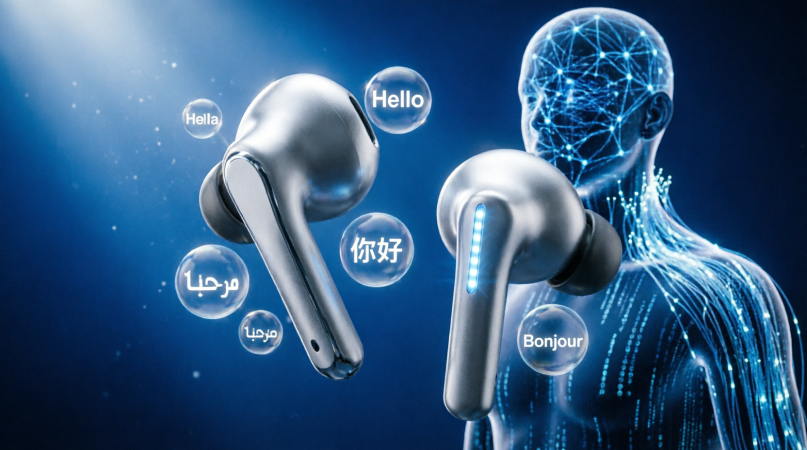
Real time translation technology is suddenly everywhere. Tech companies are racing to launch AI-powered earbuds capable of translating conversations instantly, promising a future where language barriers disappear with a single tap. The idea feels futuristic and exciting: two people speaking different languages while hearing seamless translations directly in their ears. As these devices gain attention online, many are beginning to explore how AI tools could work alongside professional interpreting services in business, healthcare, legal settings, and global communication where accuracy and human understanding still play a critical role.
AI earbuds represent one of the most impressive advances in consumer translation technology so far. They can process speech quickly, detect multiple languages, and deliver surprisingly understandable results in casual conversations. For tourism, travel, and basic communication, the technology can feel almost magical.
But once conversations move beyond simple phrases, the conversation becomes much more interesting.
Why AI Translation Earbuds Are Going Viral
Part of the appeal comes from simplicity. People love technology that removes friction from everyday life, and instant translation earbuds fit perfectly into that vision. Social media is filled with demonstrations of travelers ordering food abroad, attending international events, or speaking with strangers in different languages using only AI-powered devices.
The concept feels like science fiction becoming reality. It also aligns perfectly with the larger AI movement transforming everything from search engines to video creation. Language is simply the next frontier.
For many people, these tools are opening communication possibilities that were difficult or impossible only a few years ago.
The Difference Between Translating Words and Interpreting Meaning
What makes this discussion fascinating is that language involves much more than direct translation. Human communication depends heavily on tone, emotion, context, cultural nuance, and intention.
AI earbuds are excellent at processing speech patterns and generating rapid translations. However, conversations in professional environments often require something deeper: interpretation of meaning, emotion, and context in real time.
In a business negotiation, a pause or change in tone can alter the direction of a meeting. In healthcare, the emotional way a patient describes symptoms matters as much as the words themselves. In legal settings, precision and nuance can influence outcomes significantly.
This is where human interpreters continue to play a critical role.
Why Businesses Are Still Investing in Human Interpreting
As global business becomes more multilingual, companies increasingly recognize that communication quality affects trust. International meetings, HR discussions, legal consultations, and client negotiations often involve sensitive information where misunderstandings can become expensive.
AI tools are helping businesses move faster, but many organizations still rely on professional interpreters for conversations where clarity and human awareness are essential. Rather than replacing interpreters, technology is creating new ways for businesses to combine speed with professional oversight.
This hybrid approach is becoming more common across industries.
Where AI Earbuds Perform Best
The reality is that AI translation earbuds are incredibly useful in many everyday scenarios. Travel is one of the clearest examples. Tourists can navigate airports, restaurants, transportation systems, and hotels more comfortably than ever before.
The technology is also helpful for informal conversations, quick customer interactions, and simple multilingual communication where perfect precision is not required. In these situations, AI dramatically improves accessibility and convenience.
For many users, this is already changing how they experience international travel and communication.
The Challenges AI Still Faces
Despite rapid progress, AI translation systems still struggle with some aspects of human communication. Humor, sarcasm, emotion, regional slang, and cultural references remain difficult for machines to interpret naturally.
Fast-paced conversations, overlapping dialogue, strong accents, and noisy environments can also reduce accuracy. In professional settings, even small misunderstandings may create confusion or unintended consequences.
This does not mean the technology is failing. It means language itself is more complex than many people realize.
What 2026 Could Look Like
By 2026, AI translation technology will almost certainly become faster, more natural, and more integrated into wearable devices. Real time multilingual communication may become part of everyday life for travelers, remote workers, and international teams.
At the same time, demand for professional interpreting is likely to evolve rather than disappear. As communication becomes more global, businesses and institutions will continue looking for solutions that combine technology with human expertise.
The future may not be AI versus interpreters. It may be AI helping interpreters work more efficiently while expanding access to multilingual communication worldwide.
Technology Is Changing Communication, Not Replacing Human Understanding
AI translation earbuds represent a major technological breakthrough. They make communication more accessible and create exciting possibilities for the future. But language is not only about words. It is about understanding people, emotions, context, and intent.
Technology can help bridge language gaps instantly. Human interpreters help ensure that what truly matters inside a conversation is understood correctly.
That balance may become one of the most important aspects of global communication in the years ahead.

