
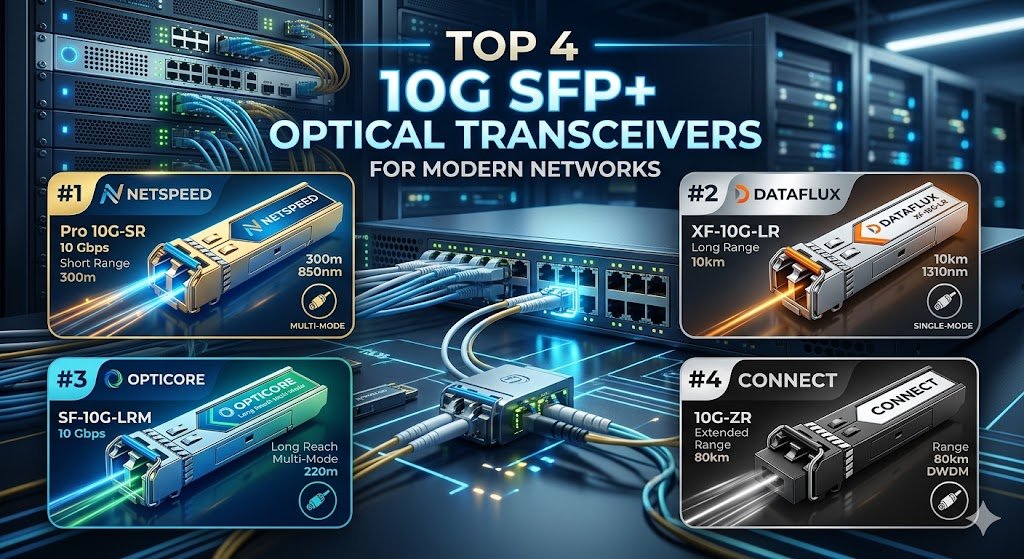
In the rapidly evolving world of enterprise networking and data centers, 10G SFP+ optical transceivers remain an indispensable component for achieving reliable, high-speed data transmission. Despite the emergence of 25G, 40G, and even 100G technologies, 10G SFP+ modules continue to deliver the best balance between performance, energy efficiency, and cost-effectiveness. For network engineers seeking scalability and stability, the right transceiver choice can make the difference between a robust architecture and persistent bottlenecks. In this guide, we explore the Top 4 10G SFP+ Optical Transceivers that dominate the market in terms of versatility, compatibility, and reliability.
10GBASE‑SR (Short Range) – The Data Center Workhorse
The 10GBASE‑SR, also known simply as 10G SR, is the most widely deployed 10G SFP+ optical module across enterprise and cloud data centers. It operates at 850 nm using a VCSEL laser over multimode fiber with duplex LC connectors. Typical transmission distances reach up to 300 m on OM3 and 400 m on OM4 multimode fiber.
This transceiver is ideal for intra‑rack and top‑of‑rack connections, where density and cost are key. It consumes less than 1 W of power and offers dependable interoperability across equipment from Cisco, Juniper, Arista, and other brands that follow the Multi‑Source Agreement (MSA) standard.
When linking high‑traffic switches or storage devices within short distances, the 10G SR module provides unmatched efficiency and ease of deployment making it the default option for most high‑density server environments.
10GBASE‑LR (Long Range) – The Enterprise Backbone
For organizations bridging multiple buildings or large campus environments, the 10GBASE‑LR optical transceiver is the go‑to solution. Operating at a 1310 nm wavelength over single‑mode fiber (SMF), it supports distances of up to 10 km while maintaining full 10G performance.
This transceiver’s low power consumption (around 1 W) and stable transmission characteristics make it perfect for aggregation switches, inter‑building fiber backbones, and data‑center interconnects (DCI). Because single‑mode fiber experiences minimal attenuation, LR modules ensure reliable connectivity even across extended stretches of physical infrastructure.
Furthermore, the LR variant is compatible with Dense Wavelength Division Multiplexing (DWDM) environments, making it adaptable for metropolitan networks and hybrid topologies that combine Ethernet and optical transport.
10GBASE‑ER (Extended Range) – Bridging the Metro Distance Gap
The 10GBASE‑ER transceiver extends optical reach even further—up to 40 km over single‑mode fiber at a 1550 nm wavelength. It utilizes higher‑power DFB lasers, enabling metro‑area links between buildings, campuses, or remote servers where repeater equipment may not be available or economical.
While ER modules draw roughly 1.5 W of power (more than SR or LR models), their ability to maintain minimal bit‑error rates over long distances makes them indispensable for medium‑haul enterprise and telecom deployments. They are also widely used for Fibre Channel and Optical Transport Network (OTN) applications, where signal accuracy and stability are mission‑critical.
When deploying ER optics, engineers should ensure proper optical attenuation balancing, as overly short fiber runs may risk receiver saturation due to high transmit power. Overall, 10GBASE‑ER offers a cost‑efficient alternative to carrier‑grade long‑haul optics for extended links.
10G DAC and AOC – High‑Performance Short‑Reach Alternatives
Not every 10G connection requires optical fiber. For data‑center racks positioned closely together, Direct Attach Copper (DAC) and Active Optical Cable (AOC) alternatives provide simple, low‑latency connectivity at a fraction of the cost.
- DAC (10GBASE‑CU):
Uses twinax copper cables with fixed SFP+ connectors at each end. Passive DACs reach up to 7 m, while active versions can extend to 15 m. They consume minimal power (around 0.2 W) and virtually eliminate electromagnetic interference, making them ideal for short‑distance switch‑to‑server links. - AOC:
Functions similarly to DAC but uses fiber instead of copper, supporting lengths up to 100 m with equally low latency. AOCs deliver improved cable flexibility and better airflow, which is vital in high‑density server racks.
Together, these integrated cable assemblies simplify installation, require no patch panels, and minimize maintenance—perfect for top‑of‑rack or intra‑cabinet interconnects.
Why 10G SFP+ Still Matters in 2026
Although 25G and 100G solutions now headline the hyperscale data‑center market, 10G SFP+ technology remains deeply relevant. Its ecosystem is mature, well‑standardized, and cost‑efficient. In fact, many Wi‑Fi 7 access points, industrial IoT gateways, and edge computing devices rely on 10G connectivity for optimal performance.
According to recent market analyses, the 10G segment continues to grow steadily, fueled by enterprise infrastructure modernization and emerging AI‑edge workloads. The ability of 10G SFP+ optics to balance affordability, bandwidth, and reliability ensures their continued deployment in small to mid‑scale networks.
Additionally, many vendors now provide dual‑rate (10G/25G) modules that future‑proof infrastructure investments, allowing gradual migration without major hardware replacement. This backward‑compatible flexibility underscores why 10G remains a “sweet spot” for networking in 2026.
Selecting the Right 10G SFP+ Optical Transceiver
When choosing among these top four transceivers, consider the following factors:
- Distance & Fiber Type:
Match module types to fiber characteristics SR for multimode short links, LR/ER for single‑mode long runs. - Environment:
Use industrial‑grade (-40 °C to 85 °C) variants for outdoor or ruggedized deployments. - Power & Cooling:
Lower‑power modules like SR and DAC reduce heat load and overall operating costs. - Vendor Compatibility:
Always ensure compliance with MSA standards and confirm transceiver coding for your specific switch firmware (Cisco, Arista, Juniper, etc.). - Budget & Scaling Plans:
SR and DAC solutions offer the most economical performance for high‑density configurations, while LR and ER suit backbone investments requiring longer reach.
Conclusion
The Top 4 10G SFP+ Optical Transceivers 10GBASE‑SR, 10GBASE‑LR, 10GBASE‑ER, and DAC/AOC solutions each address distinct network needs while sharing the same fundamental advantages: speed, interoperability, and proven reliability. For most workloads inside data centers or enterprise fiber networks, 10G SR remains the unmatched leader, offering simplicity, adaptability, and enduring value. Whether you’re optimizing rack‑scale systems or bridging metropolitan links, these transceivers ensure your network performance keeps pace with today’s demanding digital landscape.

