
Introduction
In the era of Industry 4.0, product development teams face a persistent “digital-to-physical” gap: innovative CAD designs often hit a wall when translated into physical parts. Traditional mold-based manufacturing suffers from long lead times and high costs, severely constraining iteration speed and the ability to respond to market shifts. This bottleneck delays innovation and erodes competitive advantage.
The root of this dilemma is a fundamental conflict: the production logic of traditional subtractive or formative processes, centered on rigid tooling, is inherently at odds with the flexibility of digital design. Once a mold is made, the design is effectively “frozen,” and any modification incurs massive time and financial penalties. This article reveals how metal rapid prototyping fundamentally reshapes this paradigm. It will analyze the technology’s three core advantages as a physical anchor for the digital thread “design freedom,” “integrated manufacturing,” and “rapid validation to production” providing innovators with an accelerated framework from concept to market.
How Does Additive Manufacturing Redefine the “Design for Manufacturability” Rulebook?
Additive manufacturing fundamentally rewrites the rules of design for manufacturability (DFM). Traditional DFM is a practice of compromise, requiring designs to accommodate the limitations of tools and molds avoiding internal sharp corners, adding draft angles, and splitting assemblies. In essence, it is “designing for the tool.” Metal additive manufacturing flips this script, enabling “design for function.” It allows for the creation of topology-optimized structures, complex internal channels, and integrated lattice geometries that are impossible to produce with conventional methods. This liberation unleashes unprecedented potential for performance, weight reduction, and part consolidation. As highlighted in a report by the United Nations Conference on Trade and Development (UNCTAD) on rapid technological change, this ability to achieve unprecedented design complexity and material efficiency is a key driver of sustainable industrial innovation. To fully leverage this design freedom, a deep understanding of its principles is crucial. A comprehensive metal rapid prototyping guide can help engineers systematically master all key points, from material properties to design guidelines.
- From Design Constraints to Performance-Led Optimization: Conventional manufacturing imposes strict geometric constraints. A designer cannot create an internal honeycomb structure for weight reduction if a milling tool cannot reach inside. With metal 3D printing, if it can be designed in CAD, it can be built. This enables true performance-led design. Engineers can use generative design software to create organic shapes that optimally distribute stress, resulting in parts that are up to 50% lighter while maintaining or even increasing strength. The design process shifts from asking “Can we make this?” to “What is the best possible shape for this function?”
- The Power of Part Consolidation and Functional Integration: A major benefit is part consolidation. An assembly of dozens of machined and fastened components can be redesigned as a single, monolithic 3D-printed part. This eliminates joints, fasteners, and potential failure points, improving reliability and often reducing assembly time and inventory. Furthermore, it enables functional integration. A single part can incorporate internal cooling channels that follow the contour of a hot surface, lightweight lattice structures for insulation, and mounting features all manufactured in one operation. This integration is the antithesis of traditional, assembly-dependent design.
- Material Efficiency and Sustainable Innovation: Traditional subtractive manufacturing is inherently wasteful, often removing over 90% of a raw material block. Additive manufacturing is primarily additive, building parts layer by layer and using material only where needed. This dramatic reduction in material waste is a core component of sustainable manufacturing. It allows for the economical use of high-performance, expensive alloys like titanium or Inconel. This efficiency, combined with the ability to create lighter parts for transportation (reducing fuel consumption), aligns perfectly with the goals of sustainable development highlighted in analyses of technological impact.
SLM vs. DMLS: Which Metal 3D Printing Technology Delivers Optimal Performance for Your Functional Prototype?
Selecting the right metal 3D printing technology is critical for achieving the desired performance in a functional prototype. The two dominant powder bed fusion technologies are Selective Laser Melting (SLM) and Direct Metal Laser Sintering (DMLS). While often used interchangeably, they have distinct metallurgical foundations that influence outcomes. SLM fully melts metal powder particles, creating a new melt pool and typically resulting in near-fully dense parts with excellent mechanical properties, ideal for load-bearing structural components. DMLS sinters powder by heating it to just below its melting point, fusing particles at a molecular level. It is exceptionally well-suited for complex alloys and metal matrix composites. The choice hinges on the material and the primary performance requirement of the prototype.
1. Selective Laser Melting (SLM): The Choice for High Strength and Density
SLM technology uses a high-power laser to completely melt metallic powder, layer by layer. This creates a homogeneous melt pool that solidifies into a dense, near-pore-free structure. The resulting parts have mechanical properties such as tensile strength, fatigue resistance, and ductility that are very close to, and sometimes exceed, those of cast or even wrought materials. This makes SLM the preferred choice for demanding applications in aerospace, automotive, and medical implants where ultimate part strength and material integrity are non-negotiable. It excels with pure metals and common alloys like Ti-6Al-4V, AlSi10Mg, and stainless steels.
2. Direct Metal Laser Sintering (DMLS): Mastery of Complex Alloys and Fine Features
DMLS operates by sintering powder, which involves fusing particles without reaching a full liquid state. This process typically occurs at slightly lower temperatures and can result in marginally higher porosity than SLM. However, its key advantage is exceptional control over the thermal process. This makes DMLS superb for processing challenging, high-performance alloys that are prone to cracking during full melting, such as certain nickel-based superalloys or metal-ceramic composites. It is also renowned for achieving extremely fine feature resolution and smooth surface finishes, making it ideal for intricate components like heat exchangers or conformal cooling inserts for molds.
3. Making the Strategic Choice: A Decision Matrix
The decision between SLM and DMLS should be guided by a simple matrix. For a titanium aerospace bracket requiring maximum strength-to-weight ratio, SLM is the clear choice. For a conformal cooling channel inside an injection mold made from tool steel, where thermal fatigue resistance and complex geometry are paramount, DMLS might be optimal. The best metal 3D printing service providers possess deep expertise in both technologies and can guide customers based on the material, desired mechanical properties, geometric complexity, and intended use-case of the functional prototype, ensuring the selected process delivers optimal performance.
What is “Rapid Tooling” and How Does It Serve as the Critical Bridge to Mass Production?
Rapid tooling is the strategic application of additive manufacturing to create molds, dies, or mold inserts, serving as the critical bridge between prototype validation and mass production. Instead of using CNC machining to carve a mold from solid steel over several weeks, metal 3D printing can directly fabricate a tool steel insert with optimized conformal cooling channels in a matter of days. This dramatically compresses the tooling lead time. Furthermore, these 3D-printed channels, which follow the contour of the mold cavity, enable vastly more efficient heat extraction than straight drilled holes. This can reduce injection molding cycle times by 20% or more, decrease part warpage, and improve final product quality. For startups and companies launching new products, rapid tooling enables low-risk, cost-effective pilot runs of hundreds to thousands of parts for market testing.
1. Compressing the Tooling Development Timeline
The traditional mold-making process is a sequential bottleneck involving design, machining, heat treatment, polishing, and assembly, often spanning 8-12 weeks. Rapid tooling bypasses most of these steps. A mold insert can be designed, printed, and post-processed in 1-2 weeks. This acceleration allows companies to get functional parts from the actual production material and process much earlier, enabling faster design validation against real-world manufacturing conditions and accelerating the overall time-to-market.
2. Enhancing Production Efficiency with Conformal Cooling
The true genius of 3D-printed tooling lies in conformal cooling. Traditional cooling channels are straight and drilled, leading to uneven cooling, hotspots, and longer cycle times. Additively manufactured channels can snake through the mold, maintaining a consistent distance from the cavity surface. This uniform heat dissipation allows the plastic to cool and solidify faster and more evenly. The result is not just faster cycles, but also significantly reduced part warpage and internal stress, leading to higher quality parts and lower scrap rates from the very first production run.
3. De-risking Market Launch with Low-Volume Pilot Production
For new products, committing to a $50,000+ production mold before validating market demand is a high-risk gamble. Rapid tooling, often using materials like aluminum-filled metal or soft tool steels, provides an economical path for pilot production runs of 100 to 10,000 parts. This allows companies to manufacture salable-quality parts for initial market launch, gather user feedback, and validate demand with minimal upfront investment. It epitomizes a lean, agile approach to manufacturing, perfectly aligning with the principles of smart factory integration and on-demand production.
From Aerospace Components to Medical Implants: How Does a Real-World Case Study Demonstrate Value Creation?
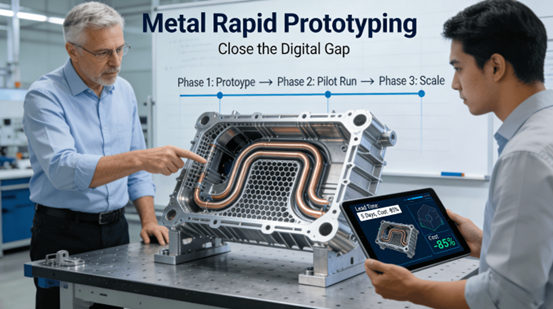
A medical device company overcame a critical design bottleneck for a portable diagnostic sensor by shifting from traditional methods to metal additive manufacturing (SLM). This enabled the monolithic printing of acomplex housing with intricate internal cooling channels in just 5 days, bypassing expensive tooling. The result was a functional, production-grade prototype in under two weeks, reducing both lead time and cost by over 85% and securing vital first-mover advantage.
- Defining the Intractable Engineering Challenge: The project’s success hinged on solving a problem that was geometrically impossible for conventional means. The required heat dissipation performance mandated a specific channel geometry that could not be accessed by a cutting tool. The choice was either to compromise the design (and thus the product’s performance) or find a new way to manufacture it. This is a classic scenario where additive manufacturing provides the only viable solution, enabling true design freedom to meet functional requirements without compromise.
- Executing the Additive Solution: The execution involved more than just pressing “print.” It required material selection (choosing an aluminum alloy for its thermal properties and printability), design for additive manufacturing (DFAM) optimization (ensuring self-supporting angles and managing thermal stresses), and defining the precise SLM process parameters (laser power, scan speed, layer thickness) to achieve a fully dense, crack-free part. The rapid turnaround was a result of a streamlined digital workflow, from CAD file to manufactured part, bypassing all traditional tooling steps.
- Measuring the Tangible Business Impact: The impact was quantified in clear business metrics: 85% reduction in lead time and cost. The intangible benefits were equally significant: accelerated innovation cycle, reduced financial risk, and the strategic gain of earlier market entry. This case demonstrates that the value of aluminum prototyping via metal AM is not just in making a part quickly, but in enabling a business strategy that is faster, leaner, and more responsive — key tenets of Industrial 4.0 technologies.
How to Navigate the Path from Prototype to Pilot Run with a Systematic Approach?
A successful journey from digital concept to physical product requires a systematic, phased approach that leverages metal rapid prototyping and rapid tooling to de-risk each step. This is not a leap of faith but a calculated staircase. Phase 1 focuses on functional validation using 3D printed prototypes. Phase 2 employs rapid tooling for market-testing via pilot production. Phase 3 is the data-informed decision to scale, choosing between long-term tooling or continued agile manufacturing. This framework provides a clear roadmap for product development, ensuring resources are committed progressively as confidence grows.
1. Phase 1: Rapid Functional Prototyping and Design Iteration
The journey begins with functional prototyping. Using metal 3D printing services, teams can produce 1-10 units of a design in the final intended material (e.g., titanium, stainless steel). This allows for rigorous testing of form, fit, and function testing mechanical loads, thermal performance, and assembly. The key advantage is speed: designs can be iterated weekly, not monthly. Failures are cheap and informative. This phase answers the question, “Does our design work as intended?” before any significant tooling investment is made.
2. Phase 2: Pilot Production and Market Validation with Rapid Tooling
Once the design is frozen and functionally validated, the goal shifts to producing a larger batch (e.g., 100-5000 units) for market testing, clinical trials, or early adopter sales. This is where rapid tooling shines. Instead of a massive investment in a hard steel production mold, a 3D-printed aluminum or soft steel mold is created. This allows for the production of parts using the actual mass-production process (e.g., injection molding) at a fraction of the cost and time. This phase validates manufacturability, supply chain, and, most importantly, market demand with minimal financial exposure.
3. Phase 3: Scaling Decision – Agile Manufacturing or Traditional Tooling?
With data from the pilot run, an informed scaling decision can be made. If demand is confirmed and stable, investment in a long-life production steel mold for high-volume manufacturing becomes a justified, low-risk decision. If demand is niche or requires ongoing customization, continuing with on-demand metal additive manufacturing for low-to-medium volume production may be the most economical and flexible path. This phased, data-driven approach epitomizes modern agile manufacturing, turning the high-risk launch process into a managed, incremental business strategy.
What Systemic Capabilities Beyond the Printer Itself Ensure Success in Metal Additive Projects?
Success in metal additive manufacturing extends far beyond the printer; it depends on a holistic technical ecosan integrated quality management system. A partner’s true capability is measured by their mastery of this entire value chain. Choosing a collaborator means evaluating their ability to fuse advanced hardware with material expertise and certified processes (like ISO 9001) to deliver consistent, high-quality results. Achieving the leap from digital model to reliable part hinges on partnering with experts who provide comprehensive, system-based professional rapid prototyping services.
1. The Foundation: Material Science and Powder Management
The quality of the final part begins with the powder. A capable partner meticulously controls metal powder characteristics: particle size distribution, sphericity, and chemical purity. They source from certified suppliers and handle powder in controlled environments to prevent contamination and moisture absorption. Degraded powder leads to defects like porosity and inclusions. Deep knowledge of material behavior, often referenced from authoritative sources like the ASM International Handbook, is essential for developing stable, repeatable process parameters that yield desired mechanical properties and microstructures.
2. The Core: Process Engineering and Parameter Optimization
A printer is a platform; the process parameters are the recipe. An experienced provider doesn’t use generic settings. They have a proprietary database of optimized parameters for different materials, geometries, and desired outcomes (e.g., high strength vs. high detail). This includes laser power, scan speed, hatch spacing, and support structure strategies. They use simulation software to predict thermal stresses and deformation, adjusting the process to mitigate issues before printing. This process engineering is the core intellectual property that separates a job shop from a true engineering partner.
3. The Guarantee: Integrated Post-Processing and Quality Assurance
Printing is only halfway. Professional post-processing is critical: stress relief heat treatment, support removal, Hot Isostatic Pressing (HIP) for porosity reduction, and precision machining of critical features. Each step must be controlled. Furthermore, a robust quality assurance system is non-negotiable. This includes in-process monitoring, coordinate measuring machine (CMM) inspection, and documentation traceability. A partner operating under ISO 9001 and industry-specific certifications (like AS9100D for aerospace) has systematized these controls, providing auditable evidence that every part meets specification. This end-to-end control transforms a promising technology into a reliable production methodology.
Conclusion
Metal rapid prototyping is far more than a “fast” way to make parts; it is a strategic enabler that redefines product development. By shattering the design constraints of traditional manufacturing, creating an agile bridge between prototype and production via rapid tooling, and relying on a systematic engineering ecosystem, it fundamentally accelerates innovation cycles and de-risks commercialization. In the competitive landscape of Industry 4.0, mastering this technology is not an option but a cornerstone for building core competencies in speed, flexibility, and performance-driven design.
FAQs
Q: How does the strength of metal 3D printed parts compare to traditionally manufactured parts?
A: With optimized process parameters and post-processing like Hot Isostatic Pressing (HIP), parts from Selective Laser Melting (SLM) can achieve mechanical properties that meet or exceed cast parts and approach forged performance. Achieving a dense, pore-free microstructure is key. Proper build orientation and heat treatment are critical for ensuring isotropic strength in high-stress aerospace or medical applications.
Q: What is the typical lead time for receiving functional metal prototypes?
A: For standard-sized parts, the typical turnaround from order to shipment is 3 to 7 business days. This includes printing, support removal, and stress relief. The core advantage is the elimination of weeks-long mold lead times. Complex requirements like precision machining or special coatings can extend this timeframe.
Q: Is metal 3D printing cost-effective for low-volume production?
A: Absolutely. For complex, low-volume parts (1 to a few hundred units), it is often more cost-effective than CNC machining or casting. It eliminates the high upfront cost of tooling and fixtures. The cost-per-part is stable regardless of geometry, making it ideal for optimized, integrated components that are prohibitively expensive to produce traditionally in small batches.
Q: What file format is best to provide for a metal rapid prototyping quote?
A: Provide a 3D CAD file in a neutral solid format like STEP (.stp). This preserves precise geometry. Also include a 2D PDF drawing with critical dimensions, tolerances, material specs, and post-processing notes. Avoid using only mesh files (STL) for quoting, as they can lose design precision.
Q: Can you 3D print assemblies as a single part to improve performance?
A: Yes, part consolidation is a major benefit. Printing an assembly as one monolithic component eliminates joints and fasteners, improving reliability, reducing weight, and enhancing thermal/fluid performance. It’s common for fuel nozzles, heat exchangers, and hydraulic manifolds, leading to stronger, lighter, and more efficient products.
Author Bio
The author is a specialist in advanced and additive manufacturing, with over 15 years of experience helping technology companies solve complex engineering and supply chain challenges. Their expertise is applied within the framework of LS Manufacturing, a precision engineering partner dedicated to providing integrated manufacturing solutions from design optimization to production. The team operates under a certified management system encompassing ISO 9001, IATF 16949, and AS9100D, ensuring systematic quality and traceability. For a professional DFAM analysis and a precise quote on your next innovation project, explore their comprehensive rapid prototyping capabilities and begin a collaborative development journey.

