
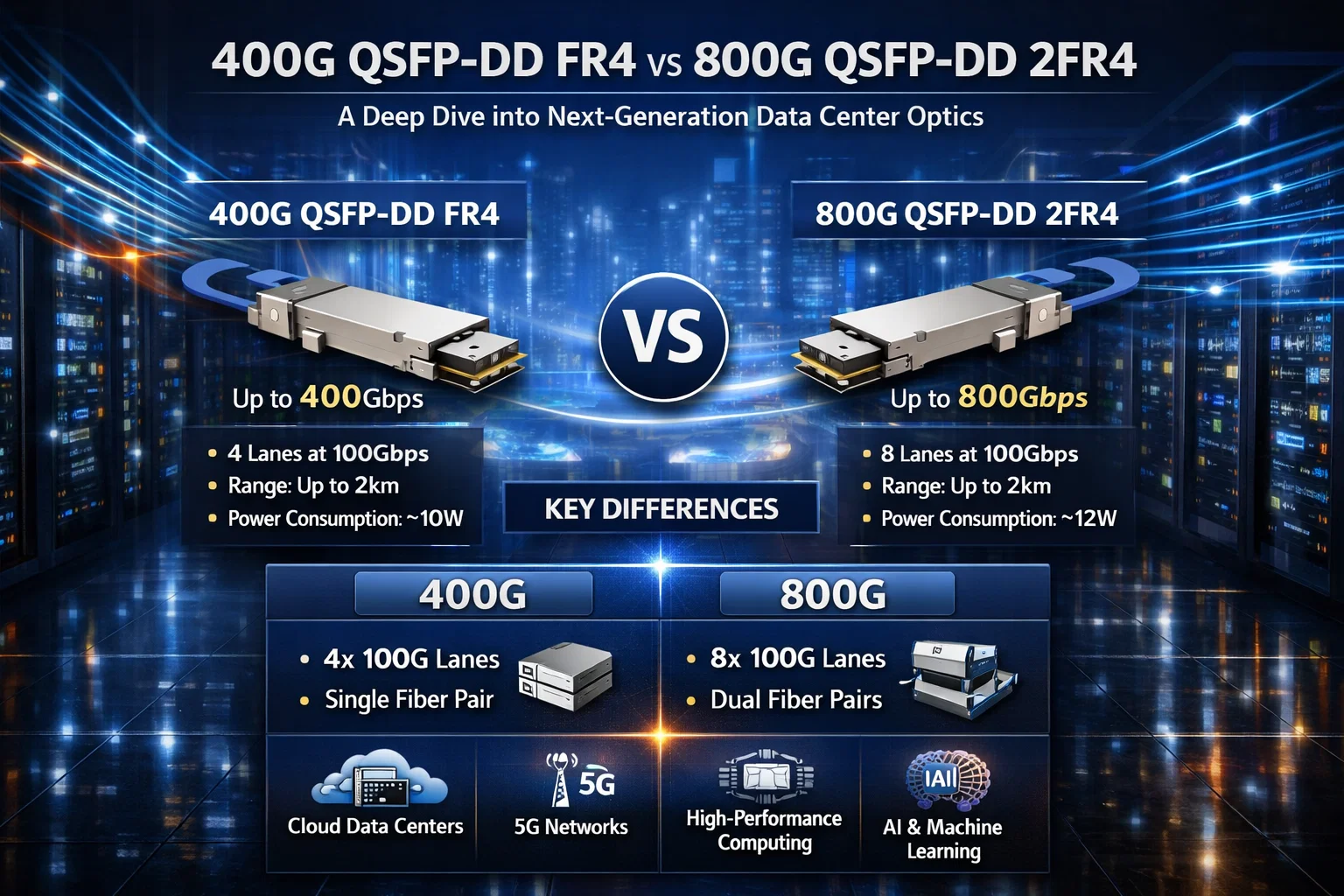
As data centers continue to expand to meet the growing demands of cloud computing, AI workloads, and high-performance networking, network operators face an ongoing challenge: how to increase bandwidth density while keeping power consumption and costs manageable. Two optical transceiver types have become key milestones in this progression the 400G QSFP-DD FR4 and the 800G QSFP-DD 2FR4.
Although these two modules share the same QSFP-DD physical interface, they represent two different points on the network evolution curve. This article explores their technical differences, performance features, and use cases, helping engineers and decision-makers understand which solution best meets their infrastructure needs.
Understanding the QSFP-DD Form Factor
QSFP-DD (Quad Small Form Factor Pluggable Double Density) is a widely adopted transceiver standard that enables 8 lanes of electrical signaling within the same compact footprint as previous generation QSFP modules. Each lane typically operates at 50G PAM4 or 100G PAM4 signaling rates, enabling 400G or 800G total module capacities depending on configuration.
The double-density design allows for backward compatibility with existing QSFP28 and QSFP56 modules, offering flexibility in deployment. QSFP-DD has become the default optical module format in large-scale data centers thanks to its optimal combination of port density, power efficiency, and ecosystem maturity.
Overview of 400G QSFP-DD FR4
400G QSFP-DD FR4 modules are designed for single-mode fiber (SMF) transmission up to 2 kilometers, making them well-suited for data center interconnect (DCI) and intra–data hall connectivity.
- Transmission rate: 400 Gbps total
- Optical interface: Duplex LC/CS connector
- Reach: Up to 2 km over SMF
- Wavelengths: 4 channels on CWDM grid (1271, 1291, 1311, 1331 nm)
- Electrical interface: 8 × 50G PAM4 lanes
- Modulation: PAM4 (Pulse Amplitude Modulation, 4 levels)
Internally, the module uses 4 optical wavelengths at 100 Gbps per wavelength (carried as 2 × 50G PAM4 signals each) and combines them via wavelength division multiplexing (WDM). This design delivers efficient lane mapping and enables major savings over solutions requiring parallel fibers.
400G QSFP-DD FR4 became a mainstay in high-density 400G networks due to its balance of cost, power (~8–10 W typical), and reach, particularly for data center leaf-spine architectures.
Overview of 800G QSFP-DD 2FR4
The 800G QSFP-DD 2FR4 represents the next step forward, effectively doubling capacity by leveraging advances in PAM4 modulation and DSP (digital signal processing) technology. The “2FR4” designation indicates two parallel FR4 optical engines, each running at 400G over four wavelengths.
- Transmission rate: 800 Gbps total
- Optical interface: Dual duplex LC/CS connectors or single MPO-12 (depending on design)
- Reach: Up to 2 km over SMF
- Wavelengths: Two sets of CWDM lanes (8 total wavelengths, 1271–1331 nm and 1351–1411 nm typical)
- Electrical interface: 8 × 100G PAM4 lanes
- Modulation: PAM4, 100G per lane
Functionally, the 800G QSFP-DD 2FR4 can be viewed as two independent 400G FR4 modules within one QSFP-DD shell, sharing a common host interface and control logic. This architecture enables interoperability with existing 400G FR4 systems in breakout mode, where one 800G module can connect to two separate 400G endpoints.
With increasing line rates and the imminent arrival of 1.6T optical modules, 800G hardware like the QSFP-DD 2FR4 serves as the bridge between existing 400G deployments and future 800G/1.6T topologies.
Key Technical Comparisons
| Feature | 400G QSFP-DD FR4 | 800G QSFP-DD 2FR4 |
| Total Data Rate | 400 Gbps | 800 Gbps |
| Electrical Interface | 8 × 50G PAM4 | 8 × 100G PAM4 |
| Optical Lanes | 4 wavelengths | 8 wavelengths (2 × FR4) |
| Reach (SMF) | Up to 2 km | Up to 2 km |
| Connector Type | Duplex LC | Dual LC or MPO-12 |
| Typical Power | ~8–10 W | ~14–16 W |
| Backward Compatibility | Compatible with 100G/200G lanes | Can break out to 2 × 400G FR4 |
| Primary Use Case | 400G leaf-spine links | 800G aggregation/core connectivity |
In terms of efficiency, the 800G 2FR4 provides double the bandwidth in roughly 1.5× the power budget, offering improved watts-per-bit performance. For hyperscale operators, that translates into higher port density and lower total cost per gigabit.
Practical Deployment Considerations
a. Network Architecture
- 400G FR4 is typically used for short-to-medium reach interconnects between top-of-rack (ToR) and spine switches.
- 800G 2FR4, meanwhile, targets high-capacity links between spine and super-spine layers or between switches supporting AI/ML clusters where bandwidth consolidation is critical.
b. Cable Infrastructure
Both modules use single-mode fiber, ensuring similar fiber plant requirements. However, 800G deployments may demand tighter insertion loss control and improved cable management due to higher optical channel density.
c. Backward Compatibility and Transition
The breakout capability of 800G 2FR4 is a significant advantage. Operators can deploy 800G-capable ports on new switches yet continue connecting to existing 400G devices, facilitating a gradual and cost-effective network migration path.
d. Power and Cooling
While 800G optics operate within modern power envelopes, cumulative thermal budgets become relevant when scaling up across hundreds of ports. Advanced thermal management and improved switch airflow design will be essential.
Cost and Availability Trends
In terms of cost per bit, 800G technology is trending downward as production scales and DSP efficiency improves. However, 400G FR4 modules remain more cost-effective in the near term, with extensive industry maturity and supplier competition.
By contrast, 800G QSFP-DD 2FR4 modules are still early in mass adoption, currently benefiting hyperscalers and large enterprises investing in future-ready infrastructure. The price premium is offset by long-term network scalability and reduced physical footprint per bandwidth unit.
Future Outlook
The evolution from 400G FR4 to 800G 2FR4 underscores the industry’s shift toward 100G PAM4 electrical signaling and higher aggregate bandwidths per port. Next-generation standards such as 800G DR8, LR4, and 1.6T OSFP-XD are already on the horizon, offering even higher density and longer reach.
Nevertheless, QSFP-DD remains a dominant and versatile form factor. The 400G FR4 will continue to serve as the workhorse for most enterprise and cloud data center links, while the 800G 2FR4 becomes the go-to solution for top-tier aggregation and AI interconnect networks.
Conclusion
Both the 400G QSFP-DD FR4 and 800G QSFP-DD 2FR4 play essential roles in the modern data center.
- The 400G FR4 offers proven reliability, strong availability, and cost efficiency for most 400G infrastructures.
- The 800G 2FR4 delivers double the capacity in the same footprint with impressive power efficiency and flexible interoperability features, making it ideal for next-generation high-density environments.
In essence, the choice between the two depends less on technology maturity and more on network scale, upgrade strategy, and application demand. For organizations planning a long-term, scalable backbone for AI, HPC, or cloud hyperscale applications, adopting 800G QSFP-DD 2FR4 technology marks a logical and future-proof evolution paving the way to the terabit era of optical networking.

