
Introduction
In the realm of industrial automation, manufacturers frequently grapple with assembly failures, unplanned equipment downtime, and reduced productivity, often traced back to inadequate tolerance control of precision components. Many attempt to achieve the critical ±0.01mm benchmark using conventional machining approaches, only to fall short due to technical limitations.
The root cause lies in the absence of a systematic methodology for precision manufacturing. Common pitfalls include inappropriate machine tool selection, suboptimal cutting parameters, inadequate temperature control, and incomplete quality verification systems. Traditional solutions often address only isolated aspects, overlooking the holistic, systematic nature of precision manufacturing as an integrated engineering discipline.
This article systematically deconstructs the complete technical framework required to achieve ±0.01mm tolerance in CNC milling. It covers every critical stage from material selection and machine configuration to process optimization and quality control, and provides a practical guide for choosing between 3-axis and 5-axis technologies. The following sections delve into the five key dimensions of the technical implementation path for precision CNC milling.
Why is ±0.01mm Tolerance So Critical for Industrial Automation Equipment?
The performance, longevity, and reliability of industrial automation systems are intrinsically tied to the microscopic accuracy of their components. In applications such as robotic joints and precision transmission systems, a ±0.01mm tolerance is not merely a specification but a fundamental requirement for seamless operation. Deviations beyond this threshold can lead to cumulative positional errors, causing binding, accelerated wear, increased vibration, and ultimately, catastrophic failure. These issues directly translate into costly production stoppages and maintenance.
Reports from the International Federation of Robotics (IFR) consistently underscore that precision manufacturing is the bedrock upon which high-performance automation is built. The correlation between tolerance control and overall system performance encompassing accuracy, energy efficiency, and total cost of ownership is unequivocal. Therefore, investing in expert Precision Manufacturing Services is a strategic imperative for deploying reliable Industrial Automation Solutions. Consistent achievement of such tolerances through precision CNC milling ensures that automated systems operate with the repeatability and durability demanded by modern manufacturing environments.
What Core Technologies Support Achieving ±0.01mm Ultra-High Precision?
Foundational Hardware and Control
This section details the core physical systems and controls essential for ±0.01mm precision, encompassing machine tool rigidity, cutting tool integrity, and stringent environmental thermal management.
- Machine and Tooling Integrity
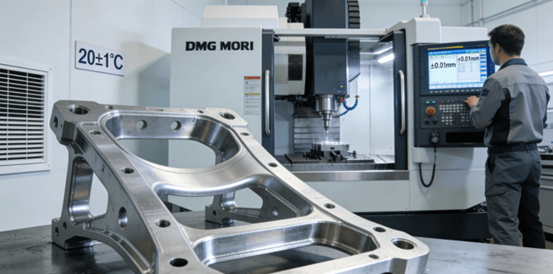
Achieving ±0.01mm precision first depends on physical system stability. This requires high-rigidity machine tools with precision drive systems to resist cutting forces. Equally critical are premium micro-grain carbide tools and balanced holders to minimize vibration and run-out, ensuring perfect cutting edge engagement.
- Environmental Mastery
Thermal stability is paramount. A controlled workshop environment (20±1°C) is mandatory. Additionally, active temperature compensation for both the machine and workpiece is often necessary to counteract thermal expansion, a primary source of dimensional error in ultra-precise work.
Process and Quality Framework
The final pillar is systematic process control. This extends beyond simple measurement to a holistic quality engineering system. It mandates adherence to international standards, employing Statistical Process Control (SPC) for real-time monitoring and ensuring full traceability. This systemic approach is fundamental to consistent, verifiable accuracy and long-term reliability.
How to Choose Between 3-Axis and 5-Axis CNC Milling for Complex Parts?
Technology Breakdown: Capabilities and Limitations
This section provides a direct comparison of 3-axis and 5-axis CNC milling technologies, detailing their core mechanical principles, ideal application scenarios, and inherent constraints. It analyzes how their distinct capabilities and limitations directly influence precision outcomes, cost, and suitability for different part geometries.
- 3-Axis Milling
Ideal for prismatic parts, 3-axis milling offers linear X, Y, Z movement. Its strengths are simpler programming, lower costs, and proven stability. However, complex parts require multiple setups, reducing efficiency and risking errors from re-fixturing, which challenges ±0.01mm consistency.
- 5-Axis Milling
By adding two rotational axes, 5-axis machining allows tool access from nearly any angle. Its key benefit is completing how does CNC milling work in one setup. This eliminates fixture errors, enhances accuracy and surface finish, and permits shorter, more rigid tools for better stability.
Strategic Selection and Application
The 3-axis vs 5-axis CNC milling choice hinges on a strategic matrix: part geometry, batch size, accuracy needs, and budget. For complex, low-volume components, 5-axis often yields better accuracy and lower per-part cost. For high-volume simple parts, 3-axis is most economical. Experts like JS Precision deploy 5-axis for intricate, thin-walled aerospace brackets, achieving supreme accuracy in a single setup.
How is the Cost Structure of Precision CNC Milling Optimized?
Pursuing CNC milling accuracy of ±0.01mm inherently increases costs, primarily from machine time, advanced programming, specialized tooling, and rigorous inspection. However, a system-wide optimization strategy can control cost without sacrificing precision.
This involves Design for Manufacturability (DFM) to avoid over-specification, and scientific process optimization using simulation to perfect parameters. Intelligent tooling management with presetting minimizes downtime, while a tiered inspection strategy using First Article Inspection (FAI) and Statistical Process Control (SPC) for critical checks replaces inefficient 100% inspection.
By adopting this holistic approach to ±0.01mm tolerance CNC milling, manufacturers can reduce total production costs by an estimated 15-30% while fully maintaining the required technical specifications and feasibility.
How to Establish a Precision Manufacturing Quality System Compliant with AS9100D Aerospace Standards?
For Precision Manufacturing Services in sectors like aerospace, an AS9100D-compliant quality system is essential. This standard mandates proactive risk management and full product lifecycle traceability beyond final inspection.
Key implementation relies on four pillars: end-to-end process control plans, comprehensive documentation for complete component traceability, rigorous supplier management, and a closed-loop continuous improvement mechanism. In practice, certified manufacturers integrate these requirements into daily operations such as maintaining detailed machine “health logs” to ensure consistent, batch-to-batch compliance.
This operational internalization of the standard ensures every part meets the stringent Quality Control Standards required for zero-defect delivery in critical applications, transforming a certification into a reliable, systemic practice.
Conclusion
Achieving ±0.01mm ultra-high precision in CNC milling is a systematic challenge that extends far beyond machine capability. It demands the synergistic integration of stable machinery, precision tooling, a controlled environment, and a holistic approach to process design and quality control. By understanding part requirements, making informed choices between 3-axis and 5-axis strategies, and optimizing cost structures from the design phase, manufacturers can meet the stringent demands of industrial automation while maintaining cost-effectiveness. Ultimately, establishing and adhering to an aerospace-level quality system like AS9100D is the definitive safeguard for ensuring this precision manufacturing capability is sustainable, reliable, and scalable for volume production.
Author Bio
This article was written by an expert in the field of manufacturing engineering, with over 15 years of hands-on experience in precision manufacturing. The author has contributed to the development of precision components for numerous industrial automation and aerospace projects, possessing a deep understanding ofCNC milling technologies and applications.
FAQs
Q1: Is the ±0.01mm tolerance in CNC milling applicable to all materials?
A1: Not all materials can easily achieve ±0.01mm tolerances. While aluminum and mild steel are more amenable, difficult-to-machine materials like titanium or Inconel require specialized tool coatings, advanced cooling strategies, and conservative cutting parameters, significantly increasing the challenge and cost.
Q2: Where are the main cost differences between 3-axis and 5-axis CNC milling?
A2: The primary differences lie in three areas: initial machine investment (5-axis is significantly higher), programming and simulation complexity/cost, and per-part cost. For complex parts, while 5-axis machine time is more expensive, its single-setup completion can reduce total fixtures and handling time, often resulting in a lower total cost for the part. The choice must be based on part geometry, volume, and a total cost analysis.
Q3: How to verify if a CNC milled part truly meets the ±0.01mm tolerance?
A3: Verification requires measurement equipment of higher precision, such as Coordinate Measuring Machines (CMM), laser scanners, or optical comparators. A robust process includes a full First Article Inspection (FAI), followed by Statistical Process Control (SPC) for critical dimensions during production, with periodic audits. All data should be recorded for process capability (Cpk/Ppk) analysis.
Q4: How much does environmental temperature affect CNC milling accuracy?
A4: The effect is significant, especially for large parts or long tool paths. The coefficient of thermal expansion of materials causes dimensional change; for steel (~0.012 mm/m·°C), a 1°C change in a 1-meter part can cause ~0.012mm change, exceeding the ±0.01mm band. Therefore, a constant temperature environment (20±1°C) is a basic prerequisite for ultra-high precision work.
Q5: Is small-batch production suitable for pursuing ±0.01mm ultra-high precision?
A5: Yes, absolutely, and it is common for high-value prototypes, jigs, or aerospace components. The strategy differs from high-volume production: it focuses more on meticulous process planning, using high-performance universal workholding, selecting versatile premium tooling, and flexible scheduling. While programming and setup costs are amortized over fewer parts, with proper optimization, achieving ultra-high precision at an acceptable cost is entirely feasible for small batches.

